Placeholder image for an article about annuities, drawdown and retirement income planning

Retirement planning

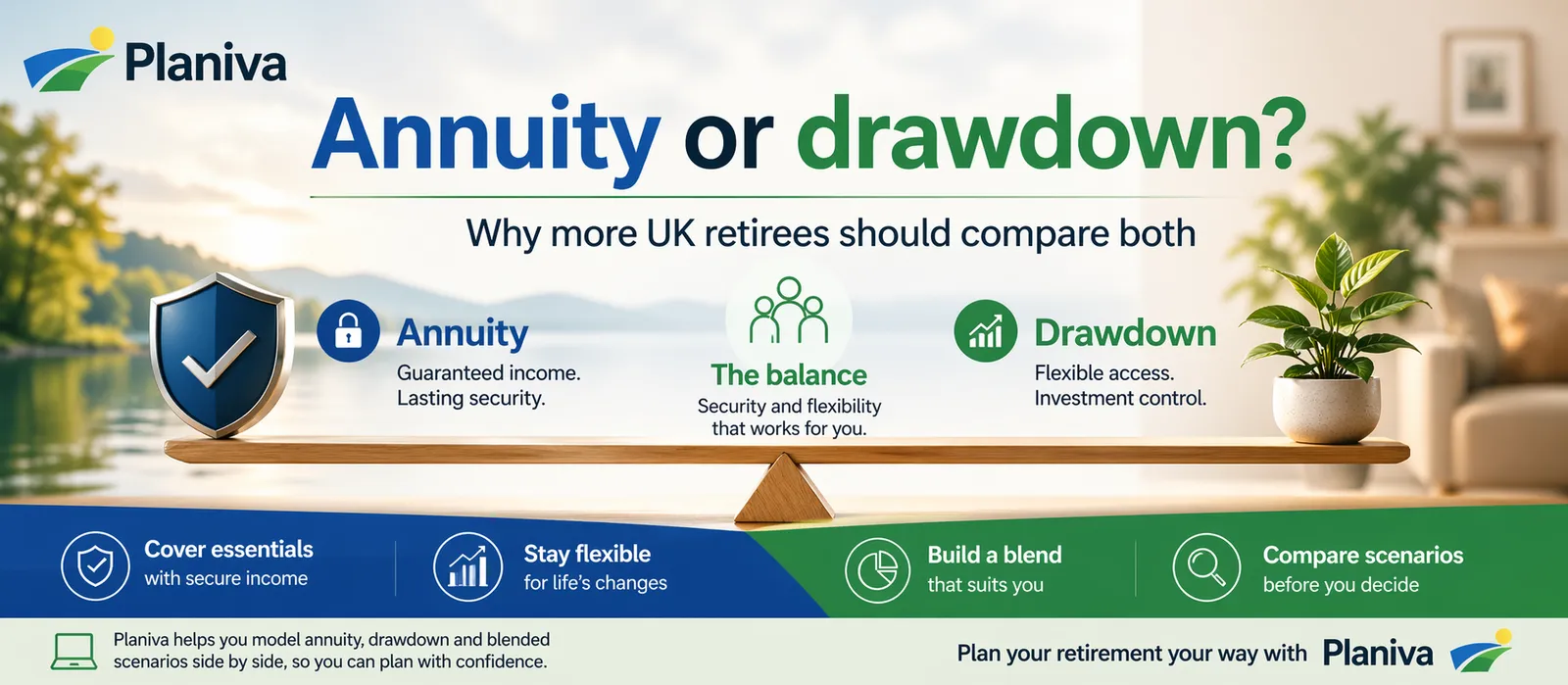
Annuity or drawdown? Why more UK retirees should compare both

22 April 20268 min readUpdated 22 April 2026
For many retirees, the real question is no longer annuity or drawdown. It is how much secure income to buy, how much flexibility to keep, and what combination still looks sensible when tested across different retirement scenarios.

Why annuities are back in the conversation

For a long time, the retirement income debate has often been framed as a straight choice. Buy an annuity for certainty, or use drawdown for flexibility. That framing is too neat, and for many households it is not especially useful.

Annuities deserve a second look in 2026, not because they are suddenly the obvious answer, but because the trade-off between certainty and flexibility looks more balanced than it did a few years ago. Rates remain materially better than they were in the low-yield period, while drawdown still offers the control and adaptability that many retirees value. The more useful question is not which product wins, but how much secure income you want and how much flexibility you want to keep.

An annuity converts some or all of a defined contribution pension into a guaranteed taxable income, either for life or for a fixed term. Once bought, it is usually not something you can easily reverse after the cooling-off period. That loss of flexibility is real, and it is one reason many people moved away from annuities after pension freedoms. But the current market is different enough that it is worth revisiting rather than dismissing.

Current market tables published by providers and platforms are only snapshots, not personal recommendations, but they are a useful reminder that annuity income today is not what many people remember from weaker-rate periods. Individual quotes still vary heavily by age, health, postcode, options selected and provider.

That does not mean annuities are back in the sense that everyone should rush to buy one. It means they can no longer be ignored quite so casually.

Why drawdown still appeals

Drawdown remains popular for obvious reasons. It lets you keep pension money invested, choose how much to take and when to take it, and spread withdrawals across tax years. That flexibility can be valuable where spending is uneven, retirement timing is uncertain, or someone wants to adapt income as markets and life change.

Part of the reason drawdown now feels more natural to many savers is that the market has changed over time. Self-Invested Personal Pensions, introduced under the Finance Act 1989, helped create a route for more engaged investors to take greater control over how pension assets are managed. A SIPP is not really a third retirement income option in its own right. It is better thought of as a pension wrapper that can make investment control and phased drawdown more attractive for some people, but that extra control is not right for everyone.

The downside is equally clear. Because the money stays invested, the value can rise and fall, and there is a real risk of drawing too much too soon. Market falls early in retirement can do disproportionate damage if withdrawals are high at the same time. Drawdown gives control, but it also leaves the retiree carrying more of the investment and longevity risk themselves.

That helps explain why flexibility still dominates behaviour, even though it is not automatically the safer or better answer for every retiree.

What annuities still do better

The strongest case for an annuity is still straightforward. It can turn part of a pension pot into known income that does not depend on markets continuing to cooperate. That can make budgeting easier and reduce the pressure to make withdrawal decisions in bad markets.

For some retirees, that matters most when covering essential spending. If core bills can be met from secure sources such as the State Pension, defined benefit income and, where appropriate, an annuity, then the rest of the retirement plan can be built with more flexibility around it. That does not remove all risk, but it can change the shape of the problem.

There are trade-offs. Annuity income is taxable. Taking more tax-free cash up front leaves less available to buy income. Level annuities can lose spending power over time, while escalating or inflation-linked options start lower. Joint-life protection, guarantee periods and value protection can all improve the shape of the income for some households, but usually at the cost of a lower starting amount.

Why the best comparison is often not annuity versus drawdown

This is where the conversation usually gets more useful. Retirement income does not have to be built around a single irreversible decision on day one. Someone might take a tax-free lump sum, keep part of the pot in drawdown, and convert another part into guaranteed income immediately or later.

For many households, the more realistic comparison is between three broad shapes of plan: mostly drawdown, mostly annuity, and a blended approach that combines both.

That middle option is often where the planning conversation becomes more realistic. It recognises that retirement is not just about maximising income on paper. It is also about how comfortable someone feels with variability, market risk, later-life uncertainty and leaving part of the pot accessible.

  • Mostly drawdown, with more flexibility, more investment exposure and more ongoing decision-making.
  • Mostly annuity, with more certainty, less flexibility and less access to capital.
  • A blended approach, with enough secure income to support essentials and the rest left invested for flexibility, growth potential and later decisions.

What people should model before deciding

The right answer depends less on ideology and more on sequencing. A serious comparison should test how secure income, tax, spending patterns and later-life priorities interact over time.

Technical details that sound minor can make a material difference. You do not necessarily have to take the full 25% tax-free lump sum before buying an annuity or using drawdown, and the way taxable withdrawals are phased across tax years can meaningfully alter the shape of retirement income.

  • How much income is already covered by the State Pension or defined benefit pensions.
  • Whether basic living costs are covered without relying on market performance.
  • Whether tax-free cash is needed now, or whether taking less preserves more income later.
  • How taxable annuity income and drawdown withdrawals interact with other income.
  • Whether spending is likely to stay flat, fall or vary across retirement.
  • Whether later-life security for a spouse or partner matters enough to justify lower starting income.
  • Whether buying an annuity in stages, rather than all at once, changes the trade-off.

Why scenarios matter more than rules of thumb

This is one area where rules of thumb are often not enough. A household with modest guaranteed income and low tolerance for volatility may look at annuities very differently from a household with strong defined benefit income, larger invested assets and more appetite for variability.

The practical way to assess that is to compare scenarios rather than chase a single best product. Model a case with more annuity income. Model another with more drawdown. Then model a middle ground where secure income covers the essentials and the rest stays flexible.

The point is not to force everyone into the middle option. The point is to see what each trade-off actually does to spending power, tax exposure, resilience and flexibility over time.

A practical conclusion

Annuities do not need a sales pitch. They need a fairer hearing than they sometimes get.

Drawdown is still the more flexible option, and for many people it will remain the better fit for part, or even most, of their pension. But higher annuity rates and a more uncertain retirement landscape mean the old habit of dismissing annuities too quickly is harder to defend.

For many retirees, the useful comparison is no longer annuity or drawdown. It is how much certainty to buy, how much flexibility to keep, and what combination still looks sensible when tested across different retirement scenarios.

Sources and further reading

This article is based on current UK consumer and regulatory sources, including MoneyHelper guidance on annuities, drawdown and pension pot options, FCA retirement income market data for 2024/25, Hargreaves Lansdown annuity rate tables published in April 2026, and UK parliamentary background material on Self-Invested Personal Pensions.

When published on the site, these sources should be added as linked references or footnotes in the final rendering so readers can verify the underlying material.

  • MoneyHelper, Take your pension as a guaranteed income: annuities explained.
  • MoneyHelper, Take money from your pension when you need it: pension drawdown explained.
  • MoneyHelper, What can I do with my pension pot?
  • FCA, Retirement income market data 2024/25.
  • Hargreaves Lansdown, Best annuity rates, quotes generated 16 April 2026.
  • House of Commons Library, Self-Invested Personal Pensions background briefing.

Related links

Compare annuity, drawdown and blended scenarios

Planiva helps you test different retirement income approaches side by side, so you can see how secure income, flexible withdrawals and changing assumptions affect the years ahead.